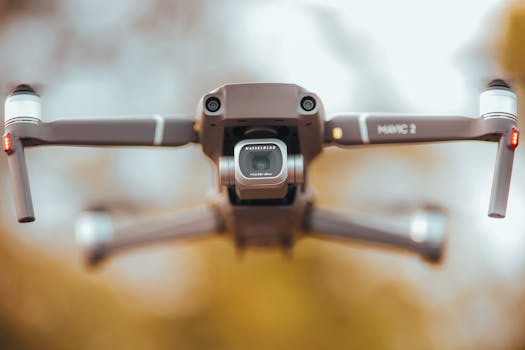
Imagine a swarm of drones, not pre-programmed to follow rigid flight paths, but intelligently adapting to dynamic environments, weaving through obstacle-laden forests, or performing complex inspection tasks with precision. This isn’t science fiction; it’s the rapidly evolving reality powered by AI for autonomous drone navigation. But what exactly does this entail, and how is it fundamentally changing what drones are capable of?
For years, drones were largely tethered to human operators or predetermined routes. While useful, this limited their potential. The advent of sophisticated Artificial Intelligence is breaking these chains, granting drones the ability to “think” and “act” independently, much like an experienced pilot, but with the advantages of tireless operation and a 360-degree perspective. This transformative technology is not just about making drones fly; it’s about making them navigate intelligently, safely, and efficiently in complex, unpredictable worlds.
Beyond Waypoints: Understanding Intelligent Flight
At its core, AI for autonomous drone navigation refers to the algorithms and systems that enable drones to perceive their surroundings, make decisions, and execute flight maneuvers without continuous human intervention. This moves us far beyond simple GPS waypoints, which are essentially pre-defined points on a map. Instead, AI-powered drones use a suite of sensors and intelligent processing to understand their environment in real-time.
Think of it like the difference between following a recipe versus improvising a meal based on available ingredients and your culinary expertise. The latter is what AI for autonomous drone navigation aims to achieve. It allows drones to react to unexpected changes, optimize their paths on the fly, and achieve mission objectives even when faced with unforeseen challenges.
The Pillars of Drone Intelligence: Sensing and Perceiving
For a drone to navigate autonomously, it first needs to understand where it is and what’s around it. This is where advanced sensing and perception technologies come into play, heavily relying on AI.
#### Seeing the World: Sensors as Digital Eyes
Drones are equipped with a variety of sensors that act as their digital eyes and ears.
Cameras: High-resolution cameras provide visual data, allowing AI to identify objects, detect features, and understand the scene. This is crucial for tasks like surveillance, mapping, and object recognition.
LiDAR (Light Detection and Ranging): LiDAR uses laser pulses to create detailed 3D maps of the environment, providing precise distance measurements and shape information. This is invaluable for obstacle avoidance and navigation in complex 3D spaces.
RADAR (Radio Detection and Ranging): RADAR is excellent at detecting objects and their speed, especially in conditions where cameras might struggle, such as fog, rain, or low light.
IMUs (Inertial Measurement Units): These sensors measure acceleration and angular velocity, helping the drone understand its orientation and movement.
#### Making Sense of Data: AI-Powered Perception Algorithms
Raw sensor data is just noise without intelligent processing. This is where AI, particularly machine learning and deep learning, shines.
Object Detection and Recognition: AI models can be trained to identify specific objects – a person, a building, a power line, a landing pad – within the sensor data. This allows drones to classify what they see and react accordingly.
Simultaneous Localization and Mapping (SLAM): SLAM algorithms allow drones to build a map of an unknown environment while simultaneously tracking their own position within that map. This is a cornerstone of true autonomous navigation, especially in GPS-denied areas.
Semantic Segmentation: This AI technique goes a step further than object detection by classifying every pixel in an image, distinguishing between different categories like “road,” “sky,” “vegetation,” or “building.” This provides a richer understanding of the operational environment.
In my experience, the accuracy and speed of these perception systems have improved exponentially over the past few years. What once took significant processing power and time can now be done in near real-time on board the drone.
The Brains of the Operation: Decision-Making and Path Planning
Once the drone understands its surroundings, it needs to decide what to do next. This involves sophisticated AI algorithms for decision-making and path planning.
#### Intelligent Decision Trees
AI systems analyze the perceived environment and mission objectives to make informed decisions. This can involve:
Obstacle Avoidance: Dynamically rerouting the drone to steer clear of unexpected objects, whether stationary or moving.
Goal-Oriented Behavior: Deciding the best sequence of actions to achieve a specific objective, such as finding a particular asset or surveying a designated area.
Risk Assessment: Evaluating potential hazards and making choices that prioritize safety and mission success.
#### Crafting the Route: Dynamic Path Planning
Path planning is the process of determining the optimal route for the drone to take from its current location to its destination, while considering all constraints and objectives. AI enables this to be highly dynamic:
Real-Time Re-planning: If an obstacle appears or the environment changes, the AI can instantly recalculate and adjust the flight path.
Optimized Trajectories: AI algorithms can plan paths that minimize flight time, conserve battery power, or avoid specific sensitive areas.
Multi-Drone Coordination: For swarms of drones, AI plays a critical role in coordinating movements, preventing collisions, and ensuring efficient coverage of an area. This is a fascinating area where emergent behaviors can arise from simple rules.
Learning and Adapting: The Power of Machine Learning
A significant aspect of AI for autonomous drone navigation is the integration of machine learning. This allows drones not just to follow pre-programmed rules, but to learn from experience and improve their performance over time.
#### Reinforcement Learning in Flight
Reinforcement learning is particularly well-suited for drone navigation. In this paradigm, an AI agent (the drone’s control system) learns by trial and error, receiving rewards for desired actions (e.g., reaching a target safely) and penalties for undesirable ones (e.g., crashing). Through repeated interactions with its environment, the AI gradually discovers optimal strategies. This is a powerful way to teach drones complex behaviors without explicit programming for every scenario.
#### Predictive Modeling
AI can also use historical data and real-time observations to predict future events, such as the movement of other aircraft or the potential for environmental changes. This predictive capability allows for more proactive and safer navigation.
Applications Flourishing with AI-Powered Navigation
The advancements in AI for autonomous drone navigation are unlocking a vast array of new applications across numerous industries.
Logistics and Delivery: Drones can autonomously navigate complex urban environments to deliver packages, optimizing routes for efficiency and speed.
Infrastructure Inspection: Autonomous drones can inspect bridges, power lines, wind turbines, and pipelines, identifying defects with greater precision and safety than human inspectors. Their ability to navigate tight spaces and varying weather conditions is invaluable here.
Search and Rescue: Drones equipped with thermal cameras and AI can autonomously search vast areas for missing persons, significantly reducing response times.
Agriculture: Precision agriculture relies on drones to monitor crop health, identify disease outbreaks, and apply treatments precisely where needed, navigating fields autonomously.
Mapping and Surveying: AI enables drones to autonomously map large and complex terrains, creating detailed 3D models for various applications.
The Road Ahead: Challenges and Opportunities
While the progress in AI for autonomous drone navigation is remarkable, challenges remain. Ensuring robust performance in all weather conditions, achieving true explainability in AI decisions, and addressing regulatory frameworks are ongoing areas of research and development.
However, the trajectory is clear. As AI continues to evolve, we can expect drones to become even more capable, safer, and more integrated into our daily lives and industries. They are poised to become indispensable tools, operating with an intelligence that allows them to navigate the complexities of our world, truly charting the unseen skies.
Final Thoughts: A Future of Seamless Aerial Autonomy
The integration of Artificial Intelligence into drone navigation represents a paradigm shift. It’s transforming drones from mere remote-controlled devices into intelligent agents capable of perceiving, reasoning, and acting independently in dynamic environments. From the sophisticated sensor fusion and perception algorithms to the dynamic path planning and machine learning, every aspect of AI contributes to this revolution.
As we look to the future, the continued development in AI for autonomous drone navigation promises to unlock unprecedented capabilities, pushing the boundaries of what’s possible in aerial operations. The journey towards fully autonomous flight is well underway, and it’s an exciting one indeed.


